Dr. Mackey Claims Jack as His Son
Young Captain Jack · The Son of a SoldierDr. Mackey Claims Jack as His Son is the first dramatic version of Jack Ruthven’s parentage to be offered by a self-interested claimant. Dr. Mackey links himself to the wreck on Hemlock Bluff, identifies the lost child as Jack, and attempts to replace the Ruthven family’s long-standing care with his own asserted blood relationship. The revelation changes Jack’s status from an adopted member of the Ruthven household into the object of a contested paternal claim, and it prepares the later correction that Jack is actually Colonel Stanton’s son.
Causes and Background
The claim begins when Dr. Mackey visits the Ruthven household to discuss the wreck. He says that the sight of the wreck has carried him back to events of about eleven years earlier and identifies himself as one of the ship’s passengers. According to his account, he was swept overboard before the vessel entered the bay, clung to a spar for hours, and was rescued by a ship bound for Cuba. The shock and exposure led hospital authorities in Havana to judge him insane; after years in an asylum, he says that his reason gradually returned. He later came to the Southern States after the war began and entered the hospital corps under General Lee.
Dr. Mackey explains his delayed return by saying that he could not determine where the ship had stranded and did not hear of the wreck on Hemlock Bluff until about three weeks before his visit. He claims that his investigation has now established that the wreck was the ship on which he, his wife, and their little son traveled. The child’s name, he says, was Jack. That name immediately connects his maritime history with the boy raised by Alice Ruthven, but the connection is initially only his testimony: the shipwreck, the dead mother, and the child’s name are presented as a chain of recognition rather than demonstrated through independent proof.
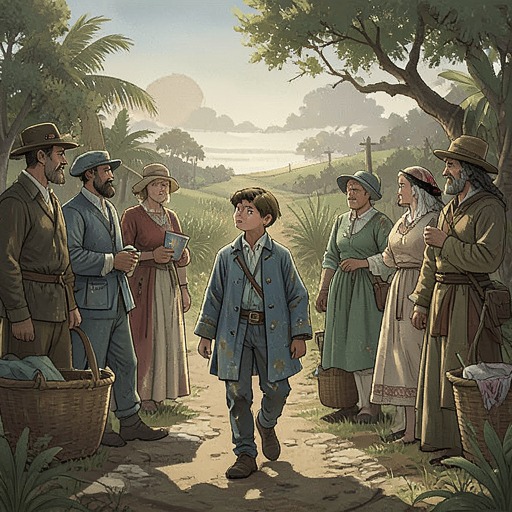
The household already possesses a different account of Jack’s origin. As a small child, Jack was found on the beach in the arms of an injured woman identified as his mother after the wreckage had struck her. Old Ben heard a cry, carried mother and child to Old Ben’s Boathouse, and went to the plantation for help. Martin Ruthven and several men brought them to the house, but the woman died soon afterward, leaving no reliable identification. Jack retains only a fragmentary memory of a storm and enormous waves, a recollection he describes as dreamlike rather than complete.
The surviving objects make the case more complicated, not simpler. Alice Ruthven kept the woman’s unmarked clothing and lace handkerchief, along with a ring worn on one finger. The ring once bore a marking, but it had been worn away beyond recognition, even after two jewelers inspected it. When Jack asks to see it, Alice brings out a small jewel casket containing the ring and handkerchief. These objects preserve the possibility of identification while withholding a decisive name, leaving room for Dr. Mackey to press a claim that the household cannot immediately disprove.
What Happens
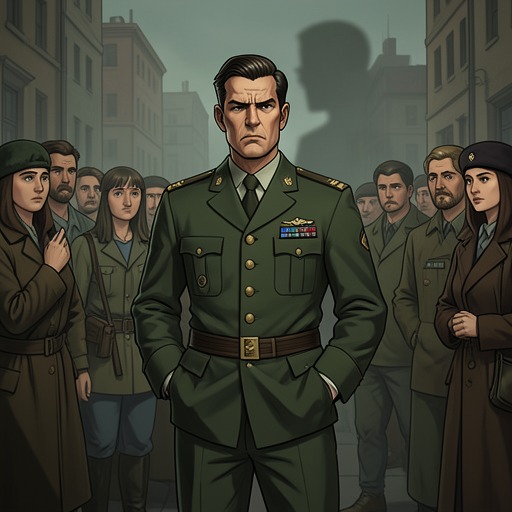
Dr. Mackey first presents the story as an investigation into the wreck, but he soon converts it into a direct assertion of authority. After meeting Jack, he alludes to Jack’s resemblance to his dead brother Walter and then declares, "Jack, I am your father!" Jack leaps back in astonishment. Dr. Mackey repeats that he is Jack’s father and catches the young man by the hand, treating the claim as an established truth rather than a proposition requiring examination.
Jack’s response is not grateful recognition but bewilderment and resistance. The supposed father is the same overbearing man who previously met him on a bridge and treated him like a slave. Jack therefore measures Dr. Mackey’s claim against conduct already experienced. He turns to Alice Ruthven and asks whether the doctor is truly his real father; Alice can answer only that this is what Dr. Mackey claims. That distinction preserves the difference between an assertion and a verified identity at the very moment Dr. Mackey tries to erase it.
Dr. Mackey also works on the emotions of the Ruthven household. He tells Alice that he understands her attachment to the boy and calls it a pity, then insists that Jack is truly his son. His apparently wounded manner seeks to make disbelief appear cruel, while his invocation of the wreck supplies the claim with a tragic narrative background. Marion Ruthven reacts with horror and asks Jack whether the revelation means she must give him up. The alleged blood tie thus threatens not only Jack’s self-understanding but also the sibling bond created by adoption.
Jack refuses to let sentiment settle the matter. He demands that Dr. Mackey prove the claim and says that he does not like the doctor’s looks because of their earlier bridge encounter. His objection joins moral judgment to evidentiary doubt: the man who now calls himself a loving father has already behaved as an aggressor. The scene’s value reversal is sharp. A father’s arrival, which might ordinarily promise recovery and belonging, instead threatens Jack’s safety and his place in the family that raised him.
Evidence, Motive, and Counterclaims
Dr. Mackey’s account gains apparent force from his stated presence on the ship and from the coincidence of the child’s name, but later testimony exposes why his story is dangerous. Colonel Stanton recalls surviving a shipwreck, prolonged exposure, hospitalization, and transfer to an insane asylum. He says that a physician at the asylum treated him brutally, extracted details of his family affairs during lucid intervals, and then drugged him. The property at issue included an inheritance in England for Stanton and an estate in Virginia belonging to his wife, Laura Stanton; the voyage had been undertaken to obtain Laura’s property.
According to Colonel Stanton, the physician learned these details and then arranged for Stanton to be recorded as incurable and subject to violent attacks, keeping him confined for years. When Stanton recovered his mind, he learned that the physician had left the asylum and disappeared. This history gives Dr. Mackey’s paternity claim a material dimension. The doctor is not merely seeking a lost child: he is associated with knowledge of a family whose property and inheritance could be obtained through manipulation. The claim’s emotional language therefore operates alongside a possible scheme to gain control of property rightfully belonging to Colonel Stanton and Laura Stanton.
The case also contains a deliberate conflict between competing identity narratives. Jack has been told that he is a nobody who does not belong to the Ruthven family; Alice corrects this by explaining that Martin Ruthven and she adopted him when he was three or four and that he is now John Ruthven, her brother. Dr. Mackey then supplies a second biological version, claiming Jack as his son. Later, Alice tells Jack that he is not Dr. Mackey’s son at all but Colonel Stanton’s son, a conclusion Stanton has proved beyond doubt. The false claim is therefore one stage in a sequence moving from adopted Ruthven, to nameless shipwreck child, to alleged son of Dr. Mackey, and finally to son of Colonel Stanton.
The objects and places associated with the wreck keep the dispute anchored in material history. The wreck itself prompts Dr. Mackey’s return; the mother’s ring and handkerchief remain in Alice’s custody; and a heavy black-painted tin box is later recovered from the wreck’s dirty, water-damaged closet. Such details make the paternity question an investigation rather than a purely sentimental exchange. The claim can be spoken in a single confident sentence, but its truth depends on whether memory, testimony, resemblance, surviving belongings, and documents form a consistent chain.
Consequences and Narrative Significance
Dr. Mackey’s declaration destabilizes the Ruthven household immediately. Jack fears separation from Alice and Marion, while the family must confront the possibility that the boy they adopted may be reclaimed by a biological parent. His uncertain status becomes actionable: the question is no longer simply who Jack is, but who has the right to direct his life and benefit from his identity.
The revelation also intensifies the contrast between social recognition and biological descent. Alice’s adoption has made Jack her son in every practical and emotional sense, and Marion knows him as her brother. Dr. Mackey attempts to make biological parentage override those relationships through assertion alone. Jack’s demand for legal proof resists that substitution. The story thereby treats identity as something built from care, memory, testimony, and evidence rather than as a fact secured merely by the strongest claimant’s voice.
Most importantly, the false claim creates suspense by offering an explanation that appears to fit several known facts while concealing its motive. Dr. Mackey really was connected with the shipwreck, and he really knows details that can make his story persuasive, but the later account of his exploitation of Colonel Stanton’s confinement reveals how knowledge can be weaponized. The same past that should reunite a family becomes a tool of coercion.
The claim’s eventual collapse clears the way for the more reliable recognition of Colonel Stanton as Jack’s father. Alice’s preserved clothing and jewelry, the wreck’s recovered evidence, and Stanton’s recovered memories belong to a broader process of verification. Dr. Mackey’s intervention is consequently both a plot reversal and a test of judgment: Jack is asked to choose between an imposed story of blood and the demonstrated loyalty of the Ruthven family, while the narrative teaches that a persuasive paternal performance is not proof of paternity.